

The Rise of AI SEO Agencies: Why Search Has Changed Forever
An AI SEO agency is a specialized firm that helps businesses get found not just on Google’s traditional blue-link results, but inside AI-generated answers on platforms like ChatGPT, Google AI Overviews, Gemini, and Perplexity.
Search has quietly broken the old rules.
Over 65% of searches now end without a single click. Users get their answer directly from an AI summary and move on. No visit to your site. No chance to convert.
That shift is already hurting revenue. Studies predict an 18% to 64% decline in organic clicks as generative search becomes the default. Some businesses are already seeing a 20–40% drop in traffic — not because their rankings fell, but because AI answered the question first.
And the scale of AI search is staggering. Over 100 million people search with AI every day. Google’s AI Overviews now appear in more than 65% of all searches. ChatGPT has over 800 million weekly active users.
The brands showing up inside those AI answers are capturing attention, trust, and intent. The ones that aren’t? They’re simply invisible.
That’s the problem a modern AI SEO agency is built to solve. It combines the fundamentals of traditional SEO — technical hygiene, content quality, authority signals — with a new layer of optimization designed to make your brand the source AI systems cite, quote, and recommend.
This guide will help you understand what these agencies actually do, what separates good ones from bad ones, and how to choose the right partner for your business.
Defining the Modern AI SEO Agency: Traditional SEO vs. GEO
To understand how an AI SEO agency operates, we must first look at how the mechanics of search have evolved.
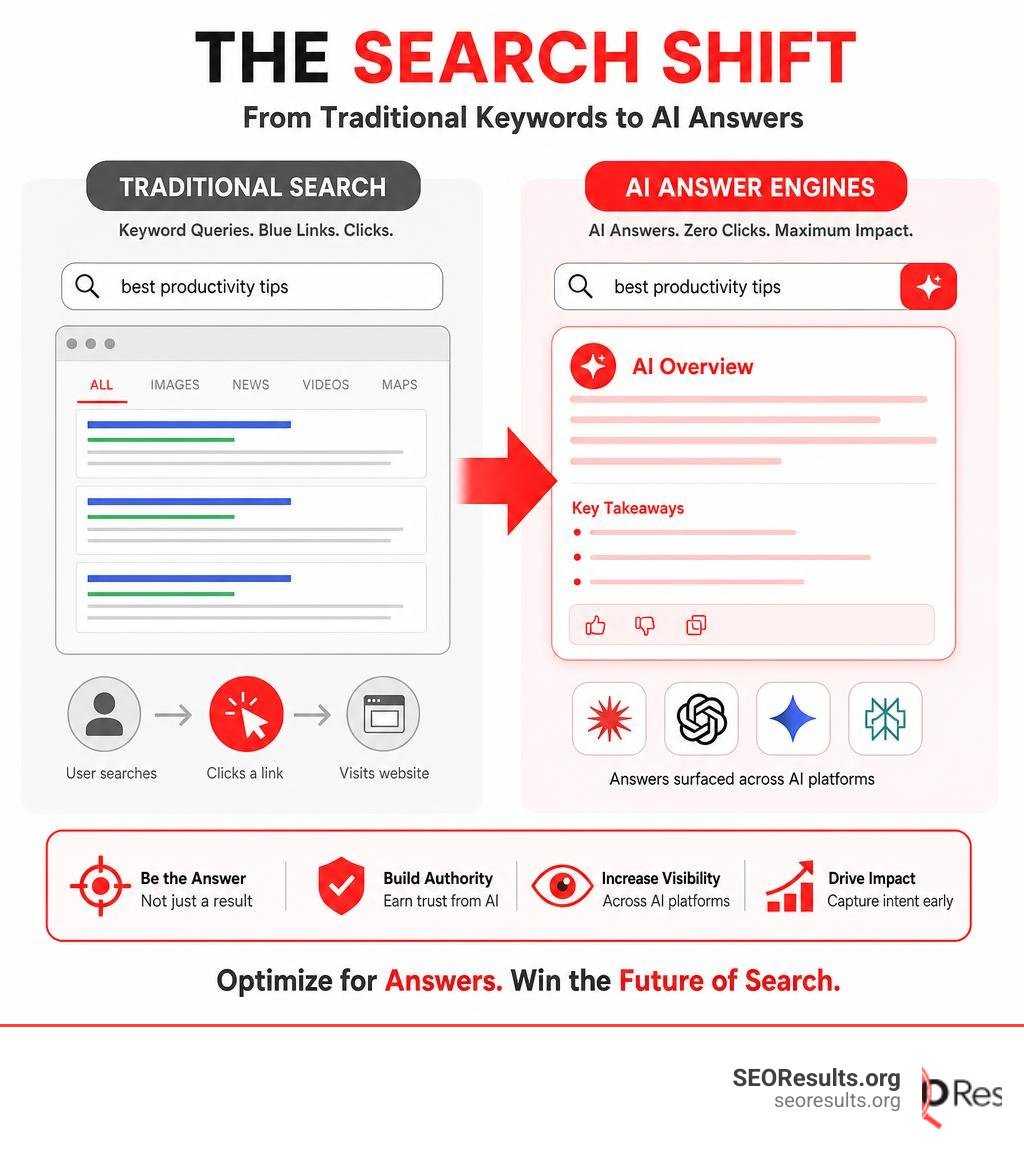
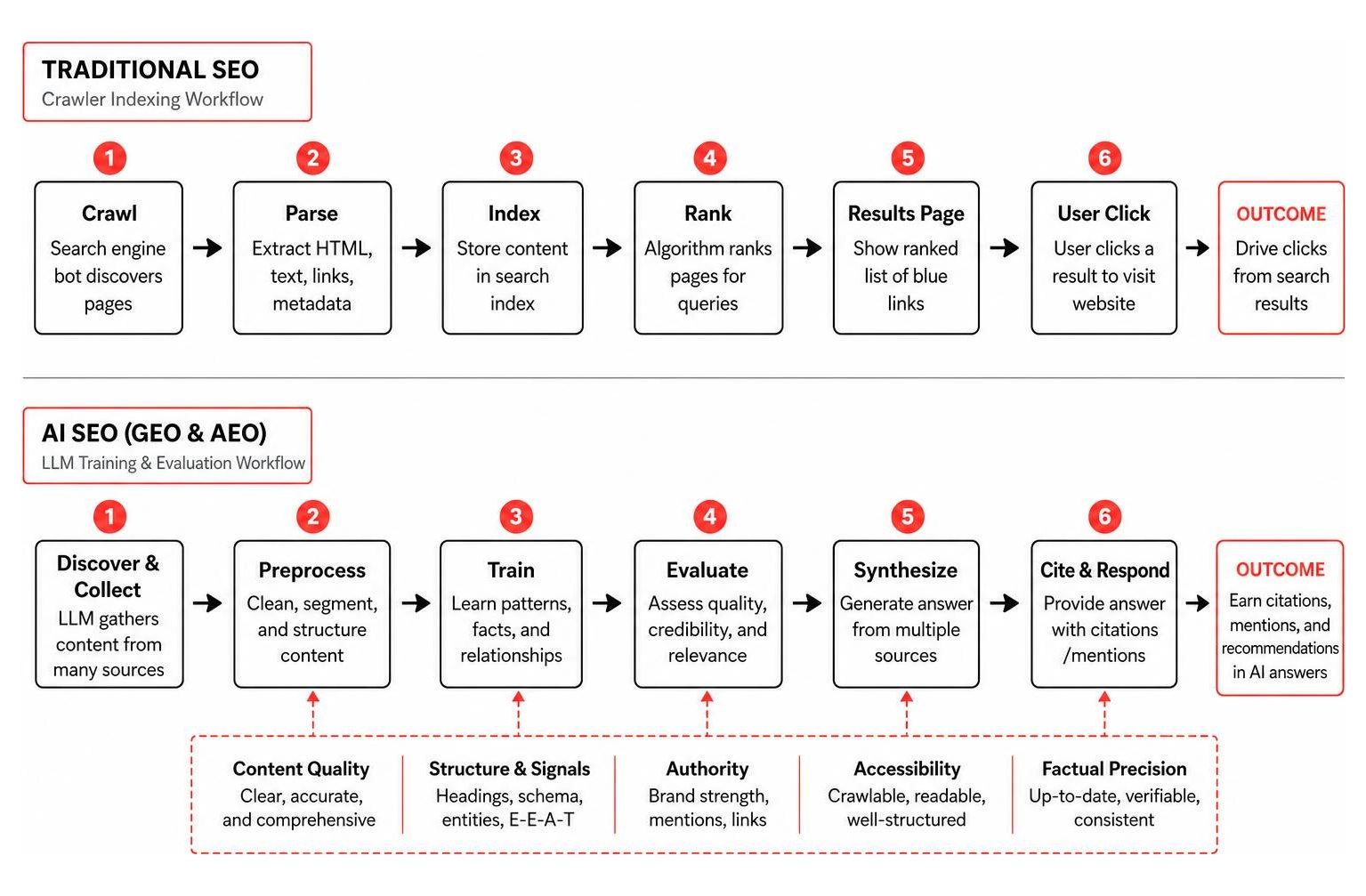
Traditional search engine optimization is designed for web crawlers. We optimize meta tags, structure headers, and build backlinks so that Google’s algorithm places our website at the top of a list of ten blue links. The goal is to capture a user’s click.
Generative Engine Optimization (GEO) and Answer Engine Optimization (AEO), on the other hand, are designed for Large Language Models (LLMs). These systems do not simply index your page; they read it, evaluate its credibility, and synthesize its information alongside hundreds of other sources to construct a single, comprehensive answer.
When a user asks an AI search engine a complex question, the AI acts as an editor. It compares competing sources, selects the most clear and authoritative passage, and displays it as a cited recommendation. If your website is not structured in a way that these models can easily extract and trust, you will never be cited — even if you rank number one in traditional search results.
Here is how these two methodologies compare side-by-side:
| Optimization Factor | Traditional SEO | AI SEO (GEO & AEO) |
|---|---|---|
| Primary Target | Search engine web crawlers (Googlebot) | Large Language Models (GPT-4, Gemini, Claude) |
| User Query Style | Short, keyword-focused (e.g., “best project management software”) | Conversational, long-tail (e.g., “Which project management tool integrates with Slack and supports agile sprints for under $50/mo?”) |
| End Goal | Rank on page one and capture organic clicks | Earn citations, brand mentions, and recommendations in AI answers |
| Content Focus | Keyword density, search volume, and comprehensive topic coverage | Structured data, factual precision, direct answers, and E-E-A-T signals |
| Key Metric | Organic traffic, keyword rankings, impressions | Citation frequency, share of voice in LLM responses, referral traffic |
At Home, we believe that traditional SEO and AI SEO are not competing strategies; they are complementary layers. Traditional SEO builds the foundational authority and technical health of your website, while AI SEO layers on the structured formatting and entity alignment required to win selection inside LLM engines.
Core Services Offered by Next-Generation Agencies
A highly capable AI SEO agency does not just write blog posts with AI writers. Instead, they provide a sophisticated suite of services designed to make your brand readable, credible, and referenceable to artificial intelligence.
- Discovery & LLM Audits: The agency runs live prompt tests across major platforms (ChatGPT Search, Gemini, Perplexity, and Copilot) to establish a baseline of where your brand stands. They analyze what your target audience is asking and determine why competitors are being recommended instead of you.
- Content Structuring & Optimization: This involves formatting your existing and new content so LLMs can easily parse it. Agencies use structured FAQs, clear definitions, comparison tables, and direct, fact-rich explainers.
- Digital PR & Brand Mentions: Because LLMs build their knowledge graphs by reading the entire web, they look for consensus. If reputable third-party publications, industry forums, and review sites consistently mention your brand in relation to a specific topic, the AI is far more likely to recommend you.
- Citation-Aware Execution: This service focuses on placing highly quotable, factually dense snippets of text within your content. When an AI engine synthesizes an answer, these snippets are designed to be easily extracted as direct quotes with a backlink to your site.
Generative Engine Optimization (GEO) and AEO
Generative Engine Optimization (GEO) and Answer Engine Optimization (AEO) are the twin engines of modern visibility.
AEO focuses specifically on optimization for conversational, direct-answer platforms like ChatGPT Search, Gemini, and Perplexity. When users type natural-language questions, AEO ensures your site provides the precise, structured answer the engine needs to satisfy the user’s query instantly.
GEO expands this strategy to hybrid search environments, such as Google AI Overviews. These platforms combine traditional search results with generative summaries. GEO strategies focus on aligning your content with semantic entities, ensuring your brand is recognized as an authority within its niche so that it is included in the synthesized summaries at the top of the search page.
Why Your Business Needs a Specialized AI SEO Agency
If your digital marketing strategy is still relying solely on traditional SEO, you are leaving your traffic and revenue vulnerable.
As search behavior shifts, queries of eight or more words have increased by 700%. Users are no longer typing fragmented keywords; they are holding conversations with search engines. With over 65% of searches ending without a click, traditional search impressions are rising, but actual organic clicks are declining.
An AI SEO agency helps you adapt to this zero-click world. Instead of chasing vanity metrics like keyword rankings, they focus on increasing your citation frequency and protecting your brand’s share of voice. By optimizing your site for AI recommendation, you ensure that when a buyer asks ChatGPT or Gemini for a product recommendation, your business is the one named, linked, and trusted.
Key Strategies for Optimizing AI Search Visibility
Earning recommendations inside AI search engines requires a shift from superficial content writing to deep authority building. LLMs are trained to detect patterns, credibility, and trust.
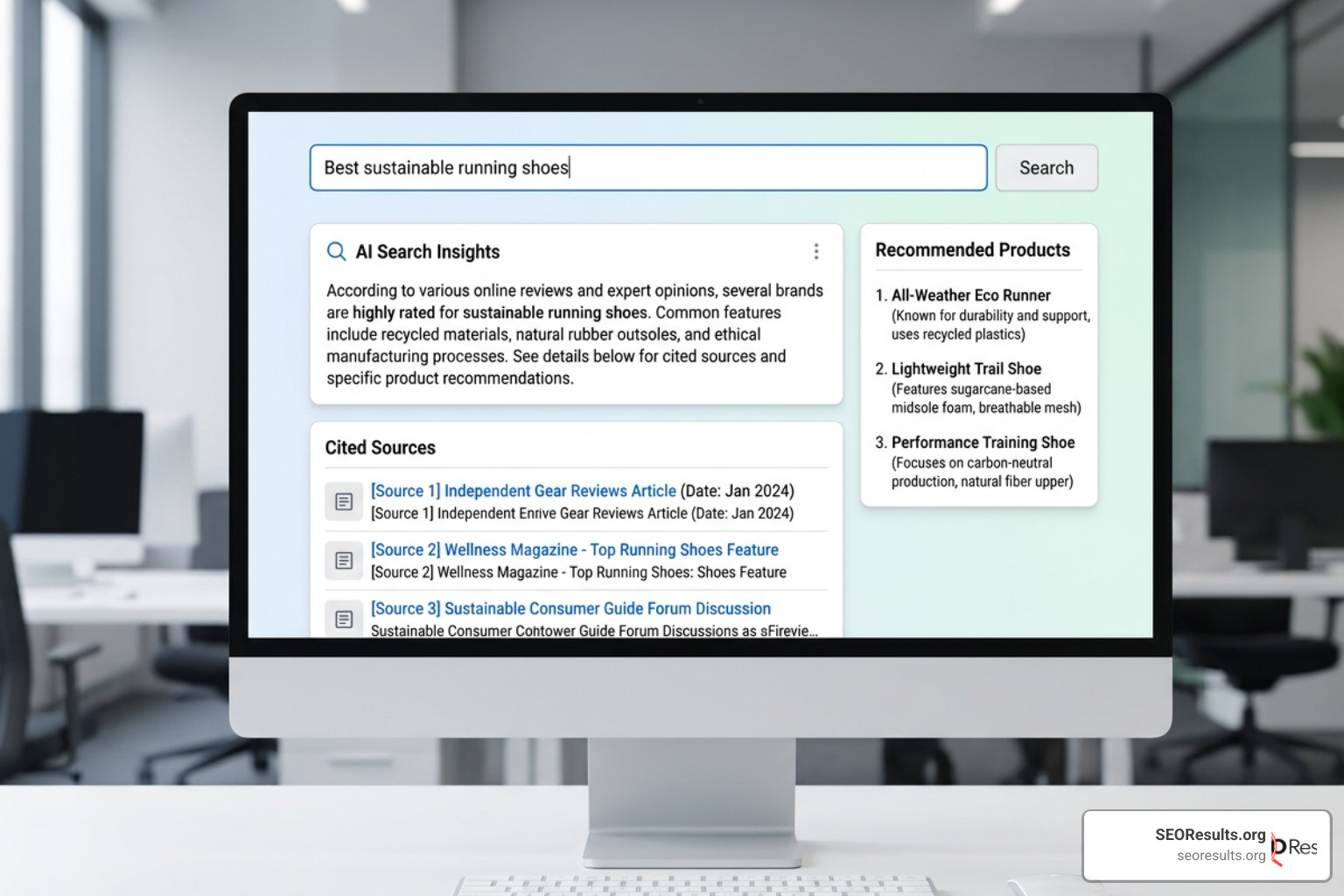
To build this trust, agencies focus heavily on Google’s E-E-A-T guidelines (Experience, Expertise, Authoritativeness, and Trustworthiness). LLMs evaluate whether your content is written by verified experts, supported by real-world data, and referenced by other trusted websites.
When creating content, we must optimize for natural language and conversational queries. This means writing the way people speak. Instead of targeting “best CRM software,” we optimize for “What is the best CRM software for a real estate agency with under ten agents?”
Technical Foundations and Schema Markup
The technical health of your website is the gateway for AI crawlers. If search engine bots and LLM scrapers struggle to crawl your site, you will be excluded from their knowledge databases.
To prevent this, we implement comprehensive structured data and schema markup. Schema acts as a translator, telling AI systems exactly what your content means. We use specific schemas, including:
- Organization Schema: To define your brand, social profiles, and official details.
- Product & Review Schema: To feed AI engines precise pricing, availability, and customer satisfaction ratings.
- FAQ & HowTo Schema: To structure questions and answers so they can be pulled directly into zero-click search modules.
For a detailed look at how to implement these technical structures correctly, you can refer to Google’s guide on structured data.
Additionally, maintaining excellent Core Web Vitals and fast page speeds remains critical. AI search engines value user experience; they are unlikely to recommend a source that takes too long to load or is difficult to read on mobile devices.
Building Topical Authority and Entity Recognition
AI engines do not look at keywords in isolation. They look at “entities” — which are real-world concepts, people, places, or things — and the relationships between them.
For example, an AI model knows that a “Certified Financial Planner (CFP)” is a highly credible entity connected to the concept of “retirement planning.” If your website only uses generic keywords like “money advice” without establishing connection to recognized entities, the AI will view your content as less authoritative.
We build this authority through structured content hubs and semantic search optimization. By creating a comprehensive network of interlinked articles that cover every subtopic of a main theme, we signal to search engines and LLMs that we possess deep, unquestionable expertise in that subject area.
How to Evaluate and Choose an AI SEO Agency
Choosing the right AI SEO agency can be challenging, especially when many traditional agencies are simply slapping an “AI” label onto their existing services without changing their underlying processes.

When evaluating potential partners, look closely at their pricing models and case studies.
- Pricing Reality: Authentic, high-quality AI search optimization is resource-intensive. Most reputable mid-market AI SEO engagements run between $2,500 and $10,000 per month. Be highly cautious of agencies offering services for under $1,000 per month; this often indicates they are using fully automated, low-quality AI content generators that can lead to search penalties.
- Documented Case Studies: Ask for proof. A legitimate agency should be able to show you documented success in rising AI Overview citations, ChatGPT referrals, or growing brand mentions across LLM platforms.
- Methodology: Ensure they have a clear, documented framework for optimizing content for AI models rather than just relying on generic SEO software.
Essential Questions to Ask an AI SEO Agency
Before signing a contract, schedule a consultation and ask these critical questions:
- How do you measure visibility and success in AI search results? (They should mention tracking metrics like citation frequency, share of voice in LLM responses, and AI-assisted referral traffic in GA4.)
- What is your approach to “human-in-the-loop” content creation? (Purely AI-generated content lacks the unique insights and E-E-A-T signals that search engines demand. Make sure they use human editors to refine and verify all content.)
- Do you recommend blocking AI crawlers from our website? (In almost all cases, the answer should be no. Blocking crawlers prevents your business from being recommended on the platforms your buyers are using.)
For more answers to common technical and strategic questions about search engine evolution, you can explore our FAQs.
Frequently Asked Questions about AI Search Optimization
Will AI Overviews cause a drop in organic traffic?
Yes, for many businesses, traditional organic traffic will decline. A study published by Search Engine Land predicts an 18% to 64% drop in organic clicks due to the rise of generative search results.
Because AI Overviews answer user questions directly on the search results page, users have fewer reasons to click through to a website. However, the traffic that does click through to your site from an AI citation is highly qualified, deeply interested, and far more likely to convert into a customer.
How is AI search optimization different from traditional SEO?
Traditional SEO is focused on ranking positions for specific keywords. It relies on keyword density, page structure, and backlink volume.
AI search optimization focuses on recommendation and entity authority. It optimizes for conversational search patterns and aims to make your brand the trusted source that an LLM extracts to build its synthesized answers. It is less about being “link number three” and more about being “the cited answer.”
How long does it take to see results from GEO?
The timeline for AI search optimization depends on your website’s baseline authority:
- Technical & Schema Fixes: Can show initial impact in AI crawling and indexing within 2 to 4 weeks.
- Content & Entity Optimizations: Typically produce measurable changes in AI Overview inclusions within 60 to 90 days.
- Compounding Authority Growth: Full pipeline impact, including steady growth in ChatGPT citations and referral traffic, generally builds over 3 to 6 months.
Conclusion
The search landscape has changed, and there is no going back. As conversational queries and zero-click answers become the standard, businesses must adapt or risk becoming invisible to their target audience.
Partnering with an experienced AI SEO agency is the most effective way to protect your digital footprint. At SEOResults.org, we specialize in delivering integrated, authority-driven systems that combine traditional technical SEO with cutting-edge GEO and AEO strategies. We don’t just help you rank; we help you get recommended.
Are you ready to secure your brand’s future in the age of AI search? Contact Us today to speak with our senior strategy team, or click below to start your optimization journey.