

Is Your Google Business Profile Costing You Customers?
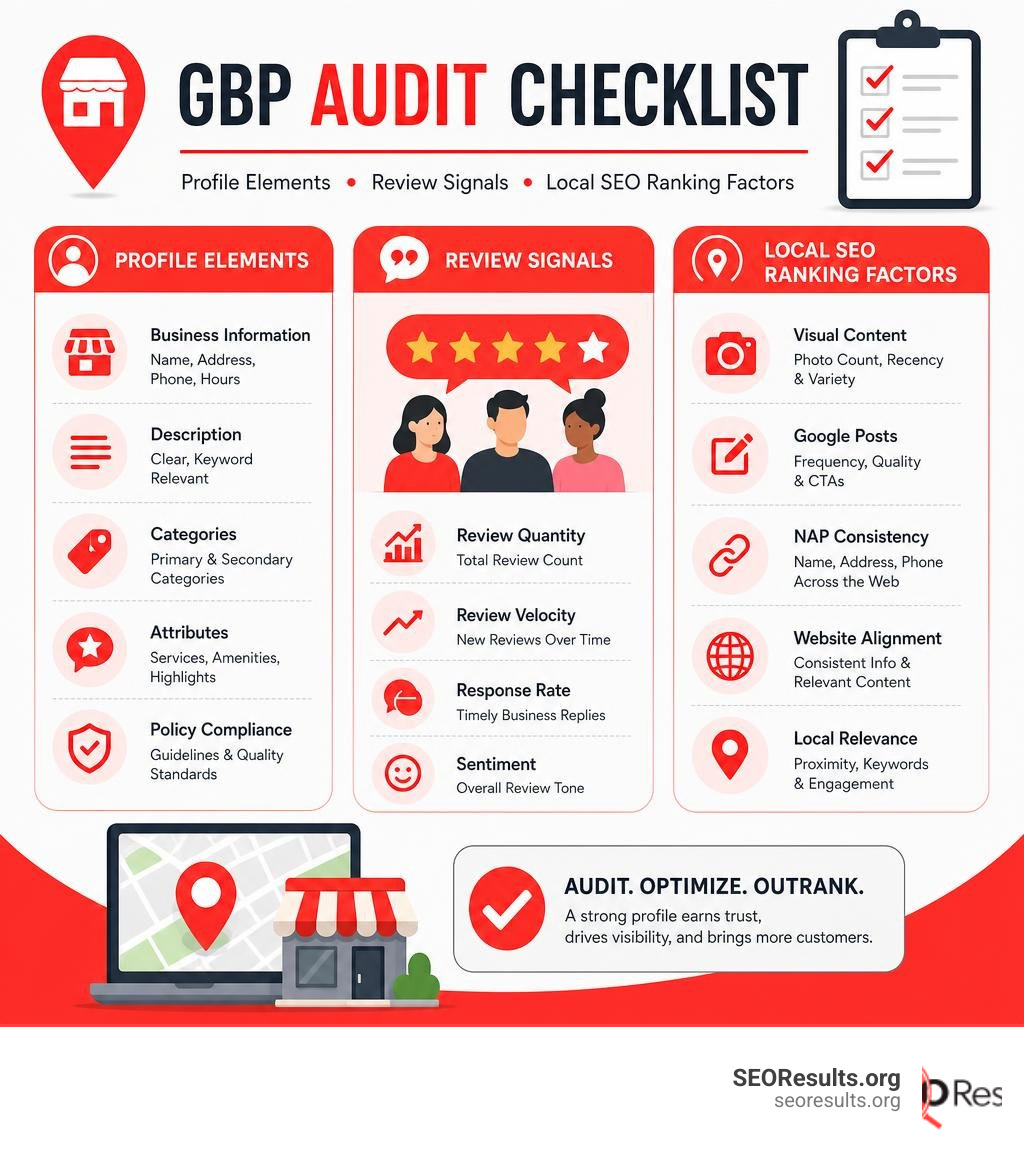
A Google My Business audit is a structured review of every signal Google uses to rank your business in local search — covering your profile data, photos, reviews, posts, categories, and how well your listing aligns with your website.
Here’s what a GBP audit checks, at a glance:
- Profile completeness — business name, address, phone, hours, description, categories, attributes
- Visual content — photo count, recency, variety (interior, exterior, team, products)
- Reviews and reputation — review count, velocity, response rate, sentiment
- Google Posts — posting frequency, content quality, call-to-action usage
- NAP consistency — whether your name, address, and phone match across the web
- Website alignment — does your linked site reinforce what your profile claims?
- Policy compliance — any signals that could trigger a listing suspension
You log into your Google Business Profile. Everything looks fine. The hours are correct. There are some photos. A handful of reviews. Then you search for the service you want to rank for — and a competitor shows up above you. Again.
That gap almost always has a root cause. And a proper audit is how you find it.
The stakes are real. 46% of all Google searches have local intent. Complete profiles get 5x more views than incomplete ones. Businesses with 100+ photos receive 520% more calls than those without. These aren’t vanity metrics — they’re the difference between a profile that generates leads and one and quietly underperforms while you wonder why.
Most businesses set up their Google Business Profile once and never look back. But rankings drift. Categories go stale. A phone number changes on the website but not on 11 directories. A holiday hours update never gets removed. Any one of these can quietly suppress your Map Pack visibility without triggering a single warning.
An audit stops the drift before it becomes expensive to unwind.
What is a Google My Business Audit and Why Does It Matter in 2026?
As we navigate July 2026, the local search landscape has shifted dramatically. A google my business audit is no longer just a simple “fill-in-the-blank” checklist. It is a comprehensive diagnostic health check that evaluates how well your business is understood, trusted, and prioritized by search engines.
Google uses over 200 ranking signals to determine who gets featured in the coveted Map Pack—where over 75% of all local search engagement occurs. These signals don’t exist in a vacuum. Instead, Google relies on entity resolution. This is a process where the search engine cross-references your profile data with your website, social profiles, and third-party directories to build a confidence score about your business. If there is a mismatch, your rankings will suffer.

Furthermore, the rise of AI-driven search engines and Generative Engine Optimization (GEO) means that platforms like Gemini and ChatGPT are actively pulling data straight from your Google Business Profile (GBP). If your profile is incomplete or unoptimized, you aren’t just invisible on Google Maps; you are invisible to the AI assistants that consumers use to make buying decisions.
Without regular audits, “ranking drift” occurs. Competitors optimize their listings, Google updates its algorithms, and your profile slowly slides down the search results. A systematic audit identifies these vulnerabilities before they cost you valuable phone calls and visits.
The Core Elements of a Comprehensive Google My Business Audit
To build a high-performing local presence, we must look at the profile as a connected system. A comprehensive audit covers several layers:
- NAP Consistency: Your Name, Address, and Phone number must be identical across your website, GBP, and all major directories. Mismatched details signal to Google that your business might not be reliable.
- Primary Category Selection: This is the single most important ranking signal on your profile. Your primary category must align perfectly with your core revenue-generating service.
- Secondary Categories: These provide context for your secondary services. Adding too many can dilute your ranking power, while missing key ones means losing out on valuable search traffic.
- Business Description: This 750-character field is your chance to use natural, localized keywords to explain who you are and what you do.
- Attributes: From “wheelchair accessible” to “identifies as veteran-owned,” attributes help you win highly specific, filtered local searches.
- Visual Content: Google tracks how users interact with your photos. High-resolution images of your storefront, team, and projects build trust and drive clicks.
- Online Reputation: We look beyond the average star rating. Google’s natural language processing (NLP) algorithms read the actual text of your reviews to understand what services you perform.
- Local Schema Markup: Your website must speak the same language as your GBP. This is achieved through structured data that mirrors your profile details.
Step-by-Step Google My Business Audit Checklist
If you are ready to roll up your sleeves and perform an audit yourself, use this step-by-step checklist to evaluate your profile’s strength.
- Verify Core Business Details: Check that your business name is your real-world operating name. Ensure your phone number is correct and your website URL points to the exact landing page optimized for that location.
- Align Website Local Schema: Implement
LocalBusinessJSON-LD schema on your website. The address, phone number, and name in the code must match your GBP down to the punctuation (e.g., “Suite 100” vs. “Ste 100”). - Audit Your Categories: Research your top three ranking competitors. What primary category are they using? If you are a remodeling contractor but your primary category is set to “General Contractor” instead of “Kitchen Remodeler,” you may be missing out on your most profitable leads. Aligning your primary category with your core service is essential for capturing high-intent local traffic.
- Evaluate Visual Assets & Geotagging: Ensure you have at least 20 high-quality photos. For service-area businesses, uploading photos taken on-site with natural smartphone metadata (geotags) provides Google with additional geographic proof of where you work.
- Analyze Review Velocity and Recency: Total review count is great, but review velocity (how fast you get new reviews) and recency (how fresh they are) matter more. A competitor with 50 recent, active reviews will often outrank a business with 300 reviews from three years ago.
- Optimize Google Q&A: Treat the Q&A section as a mini-FAQ. You can legally post your own questions and answer them yourself. Ensure you have 5 to 6 common customer questions fully answered here.
- Establish a Google Posts Cadence: Google Posts keep your profile active. Aim to publish at least one post per week, mixing promotional offers with helpful updates, always using tracking UTM links to measure clicks.
Identifying Policy Violations and Suspension Risks
A major benefit of conducting a google my business audit is catching policy violations before Google’s automated systems flag your account. A suspension can take weeks to resolve, resulting in a devastating loss of leads.
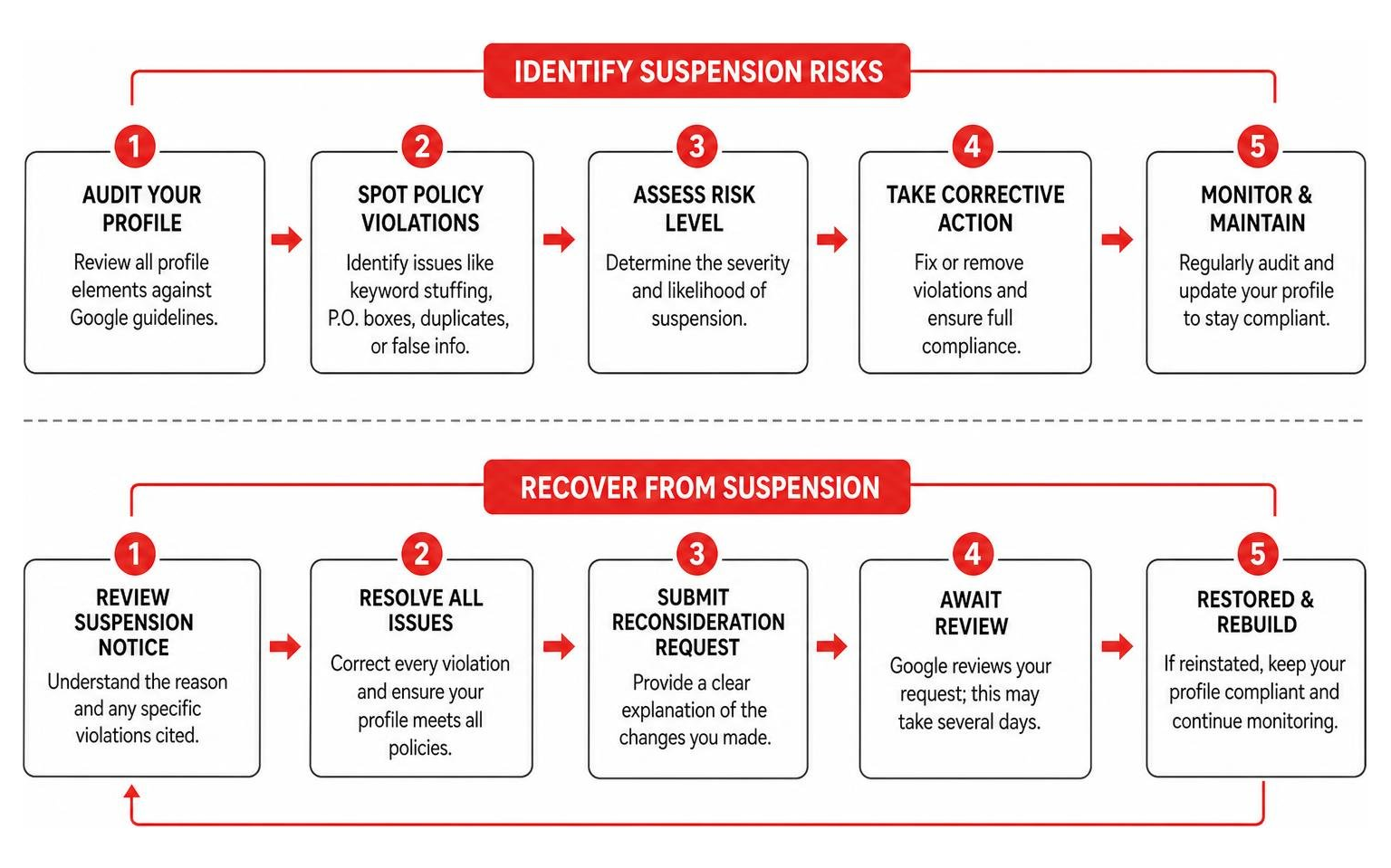
During your audit, keep an eye out for these common triggers:
- Keyword Stuffing: Adding extra keywords to your business name (e.g., “Main Street Plumbing – Best Plumber Near Me”) is a direct violation of Google’s guidelines. While it might give a temporary ranking boost, it is the number one cause of hard suspensions.
- Virtual Offices and P.O. Boxes: You must have a physical location with permanent signage and staffed hours, or operate as a designated Service Area Business (SAB). Using a UPS Store address or a virtual coworking space without dedicated physical space will trigger an immediate suspension.
- Duplicate Listings: Sometimes, multiple listings are accidentally created for the same business. Google views this as search manipulation. You must identify and merge duplicate listings through a formal support request.
- Address and Phone Number Edits: Making sudden, drastic changes to your core NAP data can trigger an automatic security lock. If you must change your address, ensure you have utility bills, business licenses, and official documentation ready for a potential reinstatement appeal.
Technical Deep-Dive: OAuth API Signals vs. Public Scanners
Many business owners run a quick scan using a public tool and assume they have completed their audit. However, there is a massive difference between what public tools can see and what can be uncovered through an authorized API connection.
Public scanners rely on the public Google Places API. This API only returns publicly visible data—such as your average rating, total review count, and public categories. It misses roughly 80% of the underlying signals that Google uses to determine local rankings.
When we perform a professional audit, we request secure Google OAuth access to connect directly to your GBP dashboard. This allows us to analyze “owner-only” data that public tools cannot touch.
This deep-dive data reveals “silent edits”—instances where Google has quietly rejected your category changes, service additions, or attribute updates without notifying you. It also measures internal engagement metrics like direct messaging response times and exact user search query volumes, giving us the raw data needed to make high-impact optimization decisions.
Why OAuth Access is Critical for a Google My Business Audit
Without OAuth access, an audit is merely a surface-level cosmetic check. By authorizing a secure API connection, we can look under the hood of your profile to extract exact search queries, customer action trends (calls, direction requests, website clicks), and photo view comparisons.
This level of detail allows us to see precisely how users behave when they find your profile. For example, if your photo views are lagging behind your competitors, we know we need to prioritize fresh visual content. If your call volume drops on specific days, we can cross-reference your listed hours and response rates to find the leak.
To experience the power of an API-driven audit firsthand, you can use the Free Google My Business Audit Tool — Free GBP Audit + Scan . This tool securely connects to your profile to evaluate 32 weighted ranking checks in under a minute, pulling real owner data that public scanners miss.
Free Audit Tools vs. Paid Enterprise Platforms
Depending on the size of your business and the competitiveness of your local market, you may choose between free self-assessment tools or robust, paid enterprise platforms.
| Feature / Capability | Free Audit Tools | Paid Enterprise Platforms |
|---|---|---|
| Data Source | Public Places API / Manual Checklists | Direct Google OAuth API Integration |
| Cost | 100% Free | Monthly subscription per location |
| Ideal For | Single-location local businesses | Multi-location brands, franchises, and agencies |
| Tracking Capabilities | One-time snapshot | Ongoing local rank tracking & automated alerts |
| Competitive Benchmarking | Basic comparison | Deep category gap analysis and geo-grid tracking |
| Reporting | Standard PDF or on-screen score | White-label, scheduled client dashboards |
If you want to run a quick, manual self-assessment without connecting your account, utilizing interactive checklists can help grade your profile completeness. On the other hand, if you are looking to benchmark your performance against local competitors in real-time, specialized local SEO audit tools can provide instant competitive insights to show you exactly where your listing falls short.
Post-Audit Strategy: Prioritizing Fixes and Competitor Analysis
Once your audit is complete, you will likely have a list of several dozen items that need attention. Trying to tackle everything at once can be overwhelming. To get the fastest results, we use an Effort vs. Impact Matrix to prioritize our optimizations.
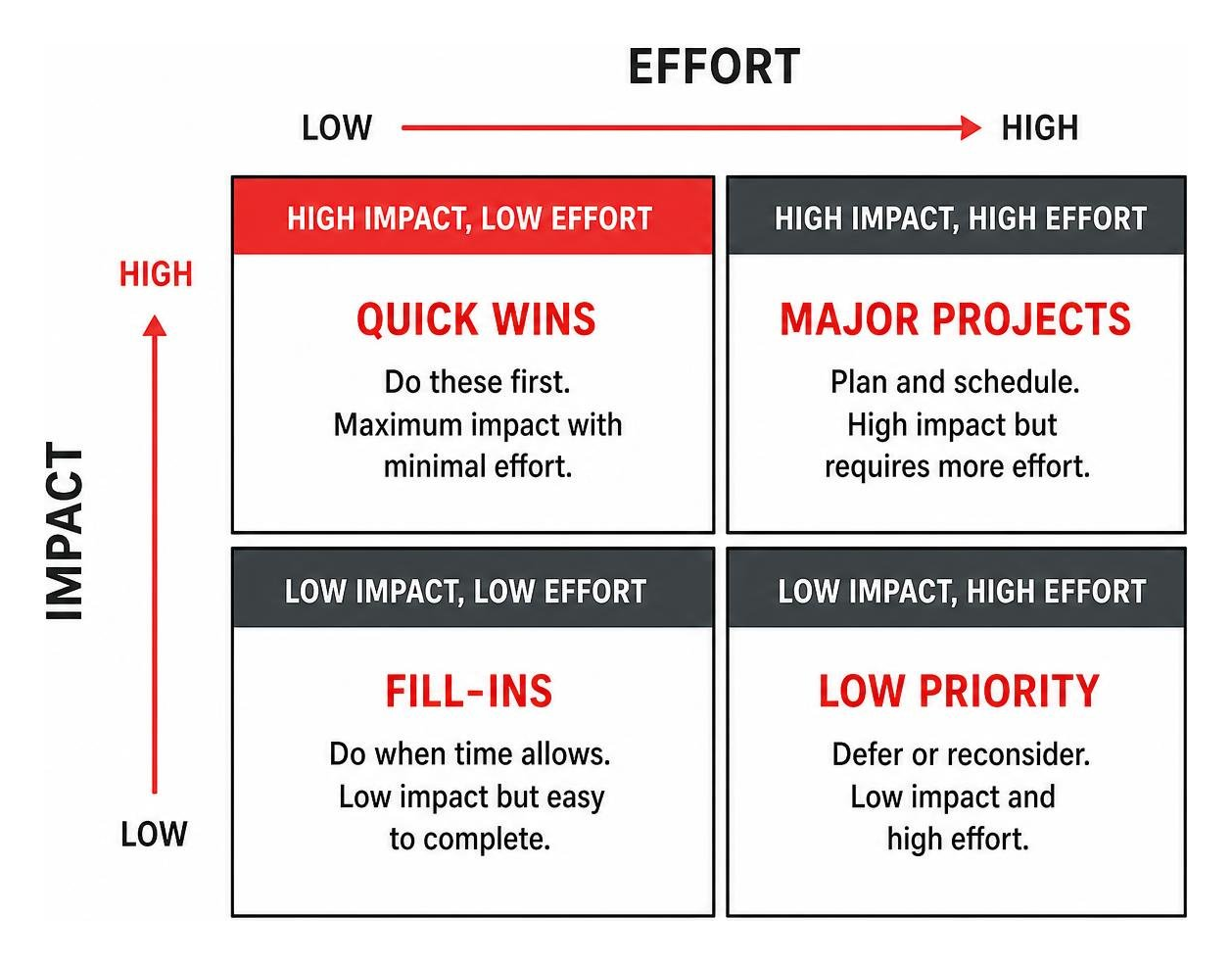
We divide our post-audit fixes into three distinct phases:
Phase 1: High-Impact, Low-Effort (Quick Wins)
These are critical ranking and trust signals that can be fixed in a single afternoon:
- Correcting primary and secondary categories to match competitor benchmarks.
- Updating missing attributes (accessibility, payment options, service offerings).
- Responding to unanswered reviews, especially those containing valuable service keywords.
- Answering any open user questions in the Q&A section.
Phase 2: High-Impact, High-Effort (Strategic Growth)
These tasks require ongoing attention but build long-term local authority:
- Implementing matching LocalBusiness schema on your website.
- Cleaning up inconsistent NAP citations across major directories.
- Building a systematic review generation campaign to increase review velocity.
- Geotagging and uploading high-quality team and project photos on a weekly basis.
Phase 3: Low-Impact, Low-Effort (Cosmetic Maintenance)
These items keep your profile fresh but won’t single-handedly move the ranking needle:
- Publishing weekly Google Posts with promotional offers.
- Refining your 750-character business description.
- Updating product and service menus with detailed descriptions and pricing.
Frequently Asked Questions
For more detailed answers to your digital marketing queries, visit our FAQs page.
How often should a business conduct a full Google Business Profile audit?
We recommend a quarterly deep-dive audit for most local businesses. If you operate in a highly competitive market (like law, home services, or medical), monthly check-ins are necessary to monitor competitor category changes and review velocities. Additionally, you should run an audit immediately following a sudden drop in rankings or after recovering from a listing suspension.
How do GBP audits help with competitor analysis and local lead generation?
An audit allows you to spy on your competitors’ local SEO strategies. By analyzing their primary categories, review velocity, and posting habits, you can identify “category gaps” where they are weak. Exploiting these gaps allows you to capture untapped search traffic, driving highly qualified local leads directly to your business.
What 2026 changes affect what a GBP audit needs to accomplish?
In 2026, AI-generated review summaries dominate the top of local search results. Google’s NLP reads your reviews from the past 6 to 12 months to create a bulleted summary of your business’s quality and services. This means your audit must focus heavily on semantic review content. Furthermore, optimizing your profile data for Generative Engine Optimization (GEO) ensures your business is recommended by AI assistants like Gemini and ChatGPT.
Conclusion
Your Google Business Profile is the digital front door to your local business. If it is slacking, you are actively handing customers over to your competitors. A systematic google my business audit is the only way to identify silent ranking leaks, protect your listing from suspensions, and align your profile with the technical signals Google demands in 2026.
At SEOResults.org, we don’t believe in surface-level checklists. We build integrated, authority-driven SEO systems that combine technical on-page optimization, powerful off-page signals, and advanced AI search visibility to drive measurable, long-term growth for your business.
Ready to stop guessing and start dominating the Map Pack? Contact Us today for a comprehensive local SEO evaluation, or explore our complete digital marketing systems at https://seoresults.org/. Let’s turn your local search presence into a repeatable lead-generation engine.
To understand how we protect your data and maintain our service standards, please review our Terms and Conditions and Privacy Policy.