
Search Is Changing Fast — Here’s What an AI SEO Expert Actually Does
An ai seo expert is a specialist who combines traditional search engine optimization with artificial intelligence tools, machine learning, and generative engine optimization (GEO) to help brands rank on both Google and AI-powered platforms like ChatGPT, Perplexity, and Gemini.
Quick answer — what does an AI SEO expert do?
- Conducts AI-powered keyword research and semantic content planning
- Optimizes content to appear in Google AI Overviews, ChatGPT, and Perplexity responses
- Builds entity authority and structured data for knowledge graph inclusion
- Uses Python automation and ML clustering to audit and fix technical SEO at scale
- Tracks AI citation frequency, organic traffic, and pipeline contribution as KPIs
If you’re a marketing leader watching your organic traffic flatten while AI answers eat your clicks, you’re not imagining it. Google AI Overviews now appear in over 65% of searches. A Search Engine Land study predicts organic clicks could fall by anywhere from 18% to 64% as generative search takes over. And 68% of Gen-Z and Millennial users in the US now start their product research on AI search engines — not Google.
The rules changed. The old SEO playbook isn’t just outdated — in some cases, it’s actively working against you.
That’s exactly why the role of the AI SEO expert exists. It’s not just about ranking on page one anymore. It’s about being the source that AI systems trust, cite, and recommend.
This guide breaks down what AI SEO experts do, how they differ from traditional specialists, which strategies actually move the needle in 2026, and how to find the right partner for your business.
Defining the Modern AI SEO Expert: Human Strategy Meets Machine Intelligence

An ai seo expert is not someone who simply copy-pastes prompts into ChatGPT and hits publish on a dozen generic blog posts. In fact, that is the fastest way to get penalized by Google’s helpful content systems.
Instead, a true AI SEO expert sits at the intersection of data science, natural language processing (NLP), and creative brand strategy. They understand how Large Language Models (LLMs) crawl, index, retrieve, and summarize information.
By leveraging machine learning and automation, they scale technical audits, cluster keywords, and map out topical authority in minutes rather than months. Yet, they keep a strict “human-in-the-loop” approach to preserve brand voice, emotional resonance, and critical E-E-A-T (Experience, Expertise, Authoritativeness, and Trustworthiness) signals.
Why Your Business Needs an AI SEO Expert in 2026
The search environment in 2026 is hyper-dynamic. Search engines are no longer just matching keywords; they are running on predictive analytics and semantic understanding.
When Google rolls out core algorithm updates, they use advanced AI models like MUM and Gemini to evaluate websites like a human expert would. If your site lacks deep topical authority, clear entity signals, or conversational formatting, your rankings can plummet overnight.
Furthermore, we are firmly in the “zero-click” era. Because Google AI Overviews appear for over 60% of commercial queries, users often get their answers directly on the search results page without ever clicking through to a website.
An AI SEO expert helps you navigate this transition. Instead of chasing vanity traffic metrics, they focus on search engine positioning—ensuring your brand is the primary source cited in those AI answers. For more context on how these systems operate, check out our FAQs.
Traditional SEO Specialists vs. AI SEO Experts
To understand how the industry has evolved, let’s look at how a traditional workflow compares to an AI-driven workflow.
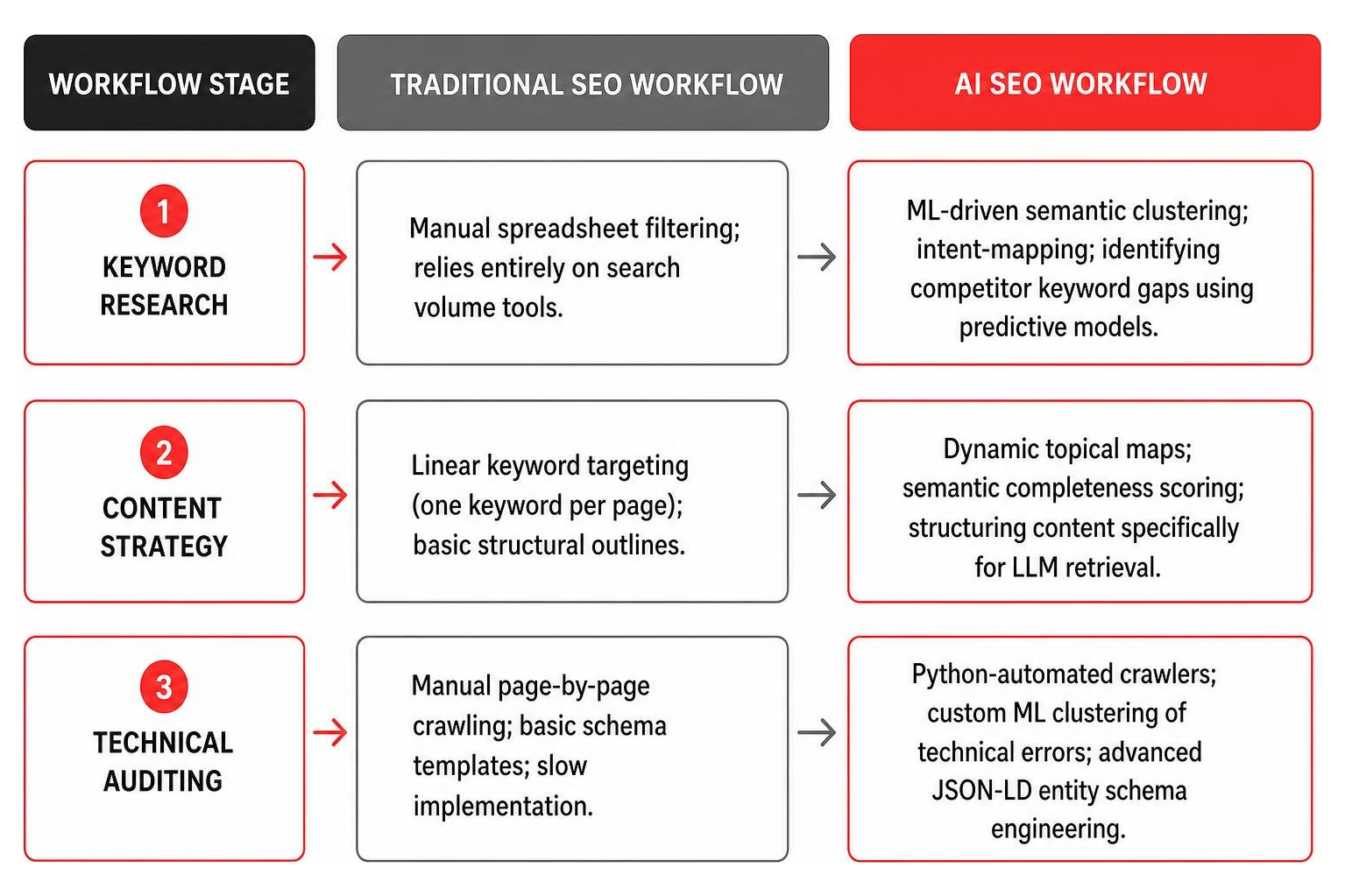
| Workflow Stage | Traditional SEO Specialist | Modern AI SEO Expert |
|---|---|---|
| Keyword Research | Manual spreadsheet filtering; relies entirely on search volume tools. | ML-driven semantic clustering; intent-mapping; identifying competitor keyword gaps using predictive models. |
| Content Strategy | Linear keyword targeting (one keyword per page); basic structural outlines. | Dynamic topical maps; semantic completeness scoring; structuring content specifically for LLM retrieval. |
| Technical Auditing | Manual page-by-page crawling; basic schema templates; slow implementation. | Python-automated crawlers; custom ML clustering of technical errors; advanced JSON-LD entity schema engineering. |
| Link Building & PR | Cold email outreach templates; manual site evaluation. | Predictive link-value forecasting; automated digital PR outreach; entity-association building across high-authority platforms. |
| Optimization Focus | Page rankings, organic traffic, and backlink quantity. | AI citation frequency, LLM visibility, featured snippet wins, and organic pipeline contribution. |
The Shift from Traditional SEO to Generative Engine Optimization (GEO)

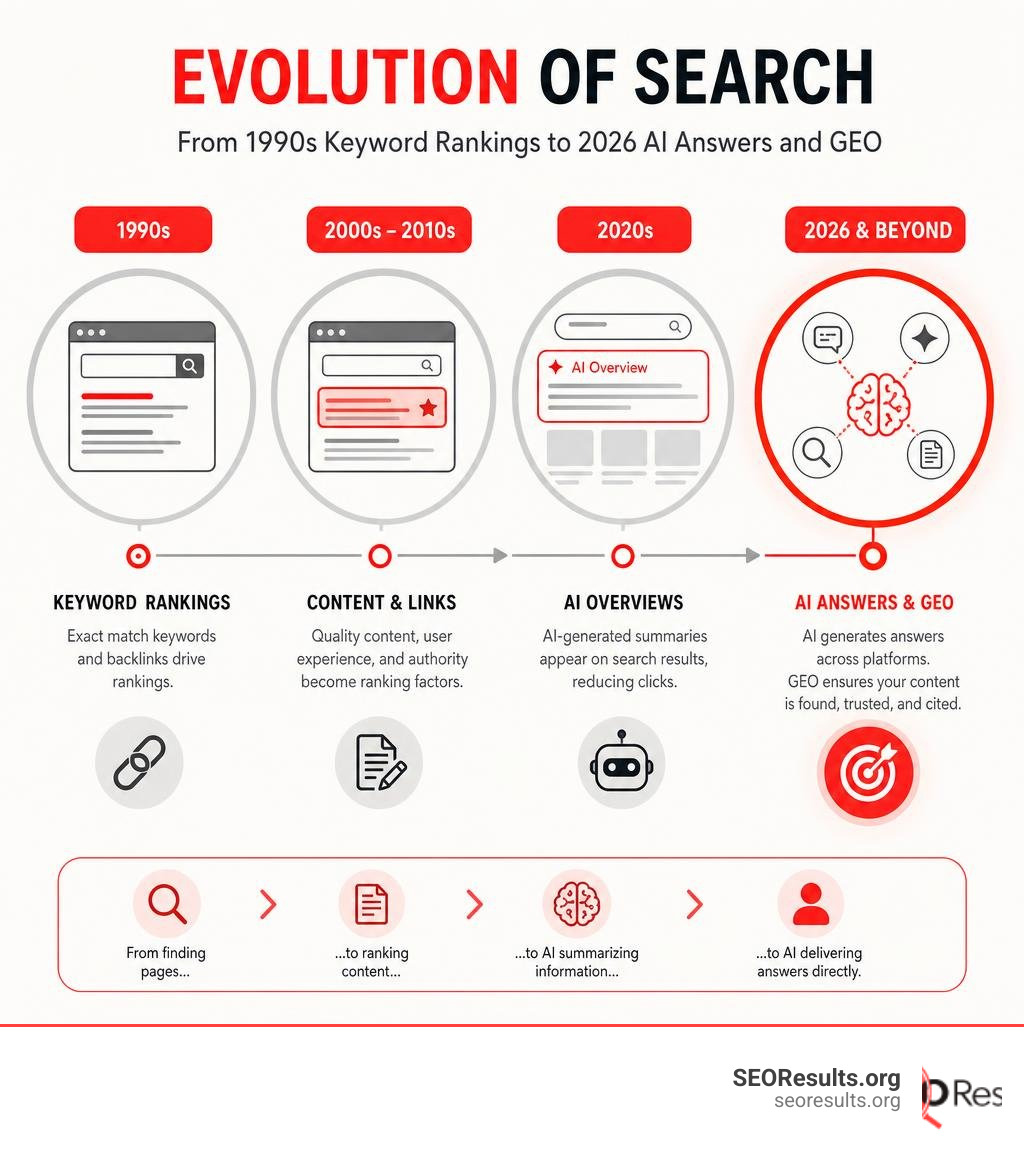
For decades, search engine optimization was a game of matching algorithms to web pages. Today, we are witnessing the rise of Generative Engine Optimization (GEO) and Answer Engine Optimization (AEO).
These methodologies do not replace traditional SEO; they expand it. While traditional SEO focuses on ranking blue links on a search page, GEO ensures that your brand is discovered, summarized, and recommended inside conversational AI interfaces like ChatGPT Search, Perplexity, Gemini, and Google AI Overviews.
Understanding the Mechanics of AI Search Citations
AI engines do not pull answers out of thin air. They rely on “citation-aware execution.” When a user asks ChatGPT or Perplexity for a recommendation, the model searches its database and live-crawled web indexes to find the most relevant, specific, and trustworthy sources. It then synthesizes an answer and inserts clickable citations.
To get your brand cited, an ai seo expert focuses on three core pillars:
- Entity Clarity: Ensuring search engines understand exactly what your business is, what products you offer, and who your experts are. This is achieved through advanced schema markup and structured data.
- Crawlable, Specific Content: Writing content with zero ambiguity. AI models prefer explicit, fact-dense language over marketing fluff.
- Knowledge Graph Integration: Establishing your brand’s presence in trusted external databases like Wikidata, Wikipedia, and authoritative industry registries.
The Impact of Generative Search on Organic Traffic
The shift to generative search has caused a notable drop in traditional organic CTRs. Some industries have reported a 20% to 40% decrease in search traffic since AI Overviews became standard.
However, there is a silver lining. While overall traffic volume might decrease, the traffic that does click through from an AI citation is incredibly high-intent.
In fact, analysis of user behavior across millions of visits shows that traffic originating from AI search platforms like ChatGPT converts at roughly 14.2%, compared to Google’s average organic conversion rate of 2.8%.
By optimizing for AI visibility, you capture the mindshare of users who are already at the bottom of the purchasing funnel.
Core Strategies and Tools of the Modern AI SEO Specialist
To win in competitive markets across the US, India, and globally, an ai seo expert deploys a highly technical toolkit. They use custom Python scripts to scrape search results, run machine learning models to cluster search intent, and use advanced NLP software to analyze content depth.
AI-Powered Keyword Research and Content Optimization
Traditional keyword volume metrics are no longer sufficient. Modern search queries are conversational, long-tail, and highly contextual.
AI-powered keyword research tools allow us to analyze massive datasets to uncover high-value conversational prompts that traditional tools miss. For instance, instead of targeting “best running shoes,” an AI SEO specialist will optimize for “moisture-wicking running shoes for flat feet under $120.”
Once the target queries are identified, we use NLP content modeling to ensure “semantic completeness.” This means analyzing top-ranking pages and AI answers to identify every sub-topic, entity, and question a user expects to find.
We then structure the content using clean Q&A blocks and passage-level optimization, making it easy for LLMs to retrieve and summarize our client’s content.
How Specialists Drive Multi-Platform LLM Visibility
To ensure your brand is recommended across ChatGPT, Gemini, and Perplexity, we build a multi-platform optimization system:
- Entity & Schema Engineering: We implement custom JSON-LD schema to explicitly link your brand to specific industries, locations, and services.
- Digital PR & Editorial Mentions: LLMs look for consistency across the web. If your brand is mentioned on major news sites, industry blogs, and review platforms, AI models are far more likely to recommend you.
- Wikipedia & Knowledge Graph Optimization: Getting your brand cited in knowledge databases acts as a massive trust signal for search algorithms.
- Hyper-Specific Landing Pages: We build crawlable, use-case-driven pages that directly answer specific user prompts.
Ready to see how your brand stacks up in next-generation search engines? Feel free to reach out via our Contact Us page for a custom audit.
How to Hire the Right AI SEO Partner for Your Business
As the demand for AI search optimization grows, many agencies have rebranded their traditional packages as “AI SEO” without changing their actual workflows. To protect your investment, you need to know how to evaluate a potential partner.
Key Skills to Look For When Hiring an AI SEO Expert
When vetting an ai seo expert or agency, look for the following technical and strategic competencies:
- Technical Acumen: Do they understand API integrations, Python automation, and machine learning models? Can they explain how an LLM retrieves information?
- Workflow Automation: They should be using AI to speed up repetitive tasks (like meta-tag generation or technical audits) while reserving human talent for strategy and content editing.
- Algorithmic Transparency: Avoid partners who promise overnight “hacks” or use fully automated, low-quality content generators. Ethical, white-hat practices are essential for long-term safety.
- Proven Case Studies: Ask for direct evidence of AI visibility. Can they show you examples of their clients being cited in ChatGPT or Google AI Overviews?
Measuring Success: AI Visibility KPIs vs. Traditional Metrics
A true AI SEO engagement focuses on revenue outcomes and brand authority rather than vanity rankings. Typical monthly retainers in the US range from $2,500 to $15,000 depending on vertical competitiveness. When tracking performance, look for these modern KPIs:
- AI Citation Frequency: How often your brand is cited or recommended in ChatGPT, Perplexity, and Google AI Overviews.
- Organic Pipeline Contribution: The actual revenue, leads, or conversions generated by your organic search channels.
- Featured Snippet & People Also Ask (PAA) Wins: Dominating search engine real estate.
- Core Web Vitals & Technical Health: Ensuring your site is fast, secure, and easily crawlable by both Googlebot and AI crawlers.
Frequently Asked Questions about AI SEO
We regularly receive questions about how the evolution of search impacts business visibility. Below are answers to the most common queries. For more detailed guides, visit our FAQs section.
Will AI completely replace traditional SEO experts?
No, AI will not replace SEO experts, but SEO experts who use AI will replace those who do not. While AI tools are incredible co-pilots for analyzing data, generating ideas, and automating tasks, they lack human creativity, strategic business understanding, and empathy. Successful campaigns require a human to direct the strategy, maintain the brand’s unique voice, and build real-world relationships.
How long does it take to see results from GEO and AI search optimization?
Technical fixes (like updating schema markup or fixing crawl errors) can show ranking improvements in as little as 2 to 4 weeks. However, building deep topical authority, securing high-quality digital PR mentions, and earning consistent citations in LLMs is a compounding process. Most businesses see meaningful momentum within 90 days, with the strongest ROI compounding between months 6 and 12.
Is Generative Engine Optimization (GEO) suitable for small businesses?
Absolutely. In fact, GEO is a massive opportunity for small and mid-sized businesses. Traditional search results are often dominated by enterprise brands with massive budgets and high domain authority.
However, AI engines prioritize relevance, specificity, and local context over brand size. By creating hyper-specific landing pages that directly answer long-tail conversational prompts, small businesses can easily outrank industry giants in AI-generated answers.
Conclusion
The search landscape of 2026 is vastly different from the keyword-stuffed era of the past. To stay visible, brands must adapt to how both humans and machines search for information.
By combining the analytical power of machine learning with strategic human creativity, an ai seo expert ensures your business doesn’t just survive the zero-click era — but thrives in it.
At Home, we specialize in building integrated, authority-driven SEO systems that combine technical precision, high-quality content, and multi-platform AI visibility. Let’s work together to future-proof your digital growth and dominate the next generation of search.